
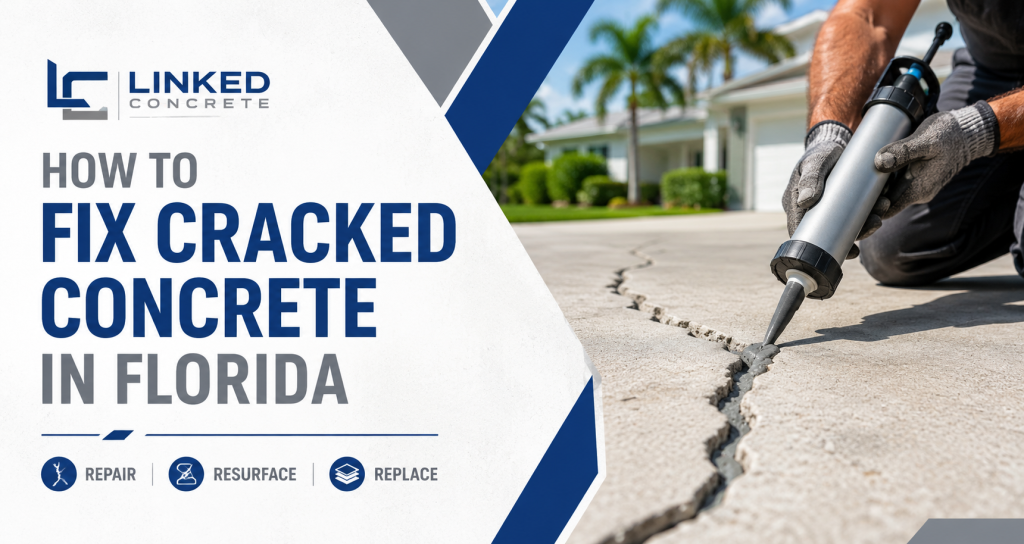
How to Fix Cracked Concrete in Florida - Repair, Resurface, or Replace
When to repair, when to resurface, and when to replace. Costs, causes, and what actually works in Florida’s climate.
$200-$800
CRACK REPAIR
$5-$14
OVERLAY /SQFT
$8-$18
REPLACE /SQFT
5
CAUSES IN FL
Every concrete surface in Florida cracks eventually. The combination of intense heat, daily temperature swings, sandy soil, heavy rain, and tree root pressure means that even properly installed concrete will develop cracks over time. The question isn’t whether your concrete will crack – it’s what to do about it when it does.
The answer depends on the type of crack, how many there are, and whether the underlying slab is still structurally sound. A single hairline crack in an otherwise solid driveway is a $50 repair. A patio with a web of cracks, uneven sections, and crumbling edges might need a $3,000 overlay or a $6,000 full replacement. Choosing the wrong option wastes money. Replacing concrete that only needed repair costs thousands more than necessary. Patching concrete that actually needs replacement buys you six months before the cracks come back.
This guide helps you figure out which category your concrete falls into and what each fix actually costs in Florida.
Not sure if you need a simple repair or full resurfacing? Our crack repair guide helps you decide between repair, resurface, and replace.
Why concrete cracks in Florida
Understanding why your concrete cracked helps determine whether the crack will get worse and which fix is appropriate.
Heat and thermal cycling
Florida concrete endures 90+ degree surface temperatures during the day and drops to 65-70 degrees at night. That daily expansion and contraction creates stress that accumulates over time. Concrete expands when hot and contracts when cool – and those movements happen at different rates across the slab, concentrating stress at the weakest points. This is why cracks often appear along control joints or at corners where stress concentrates.
Sandy soil and settlement
Much of Florida sits on sandy soil that shifts, compacts, and erodes differently than clay-based soils in other states. When the soil beneath a slab settles unevenly, the concrete loses support in one area while remaining supported in another. The unsupported section flexes under weight and eventually cracks. This is particularly common in driveways where vehicle weight concentrates on specific tire paths.
Tree roots
Florida’s aggressive tree growth sends roots under concrete slabs, lifting and cracking the surface from below. Live oaks, magnolias, and palms are the most common culprits. Root-caused cracks typically show as raised sections or humps in the slab, often accompanied by cracking on both sides of the lifted area.
Water and erosion
Florida’s heavy rainstorms wash soil out from under slab edges and through expansion joints. Over time, this erosion creates voids beneath the concrete. The slab bridges the void until weight or thermal movement causes it to crack and settle into the empty space. Pool decks and patios adjacent to landscaping beds are particularly vulnerable because irrigation water erodes the supporting soil.
Improper installation
Some cracks trace back to installation errors: too little concrete thickness, insufficient reinforcement, poor sub-base compaction, inadequate control joints, or pouring in conditions that were too hot or too wet. These cracks typically appear within the first 1-3 years and indicate a structural issue rather than normal aging.
Want to fix hairline cracks yourself? See our step-by-step DIY crack repair guide with product recommendations for Florida.
Types of cracks and what they mean
Not all cracks are equal. The type of crack tells you how serious the problem is and which fix is appropriate.
Hairline cracks (less than 1/8 inch wide)
Thin surface cracks that don’t extend through the full depth of the slab. Common in the first few years as concrete cures and shrinks. These are cosmetic, not structural. The slab is still solid underneath.
Severity: Low | Action: Seal to prevent water intrusion, no structural repair needed | Cost: $1-$3 per linear foot for crack sealant
Moderate cracks (1/8 to 1/2 inch wide)
Cracks wide enough to insert a coin. These may extend through part or all of the slab thickness. They indicate either settlement, thermal stress, or age-related deterioration. The slab may still be structurally functional but is showing meaningful distress.
Severity: Moderate | Action: Fill and seal. Monitor for continued movement. If the crack continues to widen, the underlying cause needs to be addressed. | Cost: $3-$8 per linear foot for professional crack repair
Wide cracks (over 1/2 inch)
Cracks you can fit a finger into. These typically extend through the full slab depth and indicate significant settlement, structural failure, or root damage. The slab has likely separated into independent sections that move independently.
Severity: High | Action: Professional evaluation. Repair may be possible if the slab is still level. If sections have shifted vertically, mudjacking, overlay, or replacement may be necessary. | Cost: $8-$15 per linear foot for structural crack repair, or $5-$14/sqft for overlay if multiple wide cracks are present
Pattern cracking (spider web or map cracking)
A network of interconnected cracks covering a large area of the surface. This indicates widespread surface failure – often caused by improper finishing (troweling too early), rapid drying during curing, or freeze-thaw cycling (rare in Florida but possible in the northern panhandle).
Severity: Moderate to high | Action: The surface layer has failed. Individual crack repair won’t fix this – the entire surface needs resurfacing or overlay. | Cost: $5-$14/sqft for concrete overlay
Heaving and lifting
Sections of concrete pushed upward by tree roots, soil expansion, or hydrostatic pressure. The slab isn’t just cracked – it’s displaced vertically, creating trip hazards and uneven surfaces.
Severity: High | Action: Remove the cause (root cutting, soil stabilization), then either level the slab (mudjacking/foam jacking) or replace the affected sections. | Cost: $5-$15/sqft for mudjacking, $8-$18/sqft for removal and replacement of affected sections.
Surface flaking instead of cracks? See our guide to concrete spalling repair.
Surface-level damage? Resurfacing may be the fix – see concrete resurfacing cost in Florida.
The three options: repair, resurface, or replace
Option 1: Repair (patch and seal)
Best for: Isolated cracks in otherwise sound concrete. A few hairline or moderate cracks in a driveway or patio that’s still level and structurally solid. The slab just needs crack treatment, not a new surface.
What’s involved: Clean the crack, fill with appropriate material (caulk for narrow cracks, epoxy or polyurethane for structural cracks, mortar for wide cracks), and seal. A professional can repair most residential crack jobs in half a day.
Cost: $200-$800 for a typical residential crack repair job covering 3-10 cracks. Per linear foot pricing runs $3-$15 depending on crack width and depth.
Lifespan: Repair material lasts 3-5 years in Florida before reapplication may be needed. The repair doesn’t prevent new cracks from forming – it addresses existing ones.
When this isn’t enough: If you have more than 10-15 cracks across a single slab, or if the slab has significant settlement or heaving, individual crack repair is putting bandaids on a bigger problem. You need resurfacing or replacement.
Option 2: Resurface (concrete overlay)
Best for: Widespread surface damage on a structurally sound slab. Multiple cracks, surface scaling, discoloration, or outdated appearance – but the slab itself is still level and solid underneath.
What’s involved: The existing surface is cleaned, ground or shot-blasted for adhesion, and a new layer of polymer-modified concrete is applied on top. The overlay is typically 1/4 to 3/4 inch thick and can be finished smooth, textured, stamped, or colored. The result is a completely new surface over the existing concrete.
Cost: $5-$14 per square foot depending on thickness, texture, and decorative finish. A 500 sqft driveway overlay runs $2,500-$7,000. A 400 sqft patio overlay runs $2,000-$5,600.
Lifespan: 10-15 years for quality overlay systems in Florida. Requires resealing every 2-3 years to maintain appearance and adhesion.
When this isn’t enough: If the slab has significant settlement (sections sitting at different heights), large voids underneath, or severe structural cracking, an overlay will crack along the same lines as the original concrete within 1-2 years. The slab underneath needs to be stable for an overlay to work.
Option 3: Replace (tear out and repour)
Best for: Concrete that’s beyond repair – severe settlement, multiple wide structural cracks, root damage that has lifted and separated sections, or concrete that’s so old and deteriorated that the surface is crumbling.
What’s involved: The old concrete is broken up (jackhammered), hauled away, the sub-base is re-graded and compacted, new forms are set, and fresh concrete is poured. This is the most expensive option but gives you a completely new slab with a full lifespan ahead of it.
Cost: $8-$18 per square foot including demolition, hauling, sub-base prep, and new pour. A 500 sqft driveway replacement runs $4,000-$9,000. A 400 sqft patio replacement runs $3,200-$7,200. Add $4-$8/sqft for decorative finishes (stamping, staining, coloring).
Lifespan: 25-50 years for properly installed concrete in Florida.
When this is overkill: If the slab is still level and structurally sound, tearing it out wastes $2,000-$5,000 that a $2,000-$7,000 overlay would have avoided. Always get the slab evaluated before assuming replacement is necessary.
Quick decision guide
A good contractor will tell you honestly whether your slab needs repair, overlay, or replacement. Be wary of anyone who recommends full replacement without explaining why an overlay won't work.
Florida-specific repair tips
Use flexible sealants, not rigid fillers. Florida’s temperature swings cause concrete to move constantly. Rigid crack filler (like standard concrete caulk) cracks again within a season. Use polyurethane or silicone-based flexible sealants that move with the concrete.
Address drainage before repairing. If water is pooling against your slab or washing soil out from underneath, fixing the cracks without fixing the drainage means the cracks come back. Grade the surrounding soil away from the slab and ensure downspouts direct water at least 4 feet from concrete surfaces.
Time your repairs for the dry season. November through March gives you the best conditions for crack repair, overlay work, and new pours. Lower humidity improves adhesion for overlay products and sealants. Fewer afternoon storms mean fewer delays.
Get root barriers installed. If tree roots caused the damage, cutting the roots and repairing the concrete without installing root barriers means the roots grow back and the damage repeats in 3-5 years. Plastic or metal root barriers redirect growth away from the slab.
Want to fix hairline cracks yourself? See our DIY guide.
After repairing cracks, seal the surface to prevent water from getting back in. See the best sealers for Florida.
Find a concrete repair contractor in your county
Browse by county. Contact them directly. No shared leads.
Also read
How Much Does Concrete Resurfacing Cost in Florida? - overlay pricing
How Much Does a Concrete Driveway Cost in Florida? - replacement pricing
How Much Does a Concrete Patio Cost in Florida? - patio pricing by finish
Pool Deck Resurfacing Options in Florida - pool deck repair guide
When to Reseal Decorative Concrete in Florida - maintenance schedule
Types of Decorative Concrete for Florida Projects - finish options